
Assessing Company Readiness for a Management Buyout: A Framework for Stewardship
What if the ultimate measure of your success isn't the growth you've achieved, but how well the enterprise thrives once you've walked away? Many founders view their company as a personal extension of their identity, yet true legacy requires the business to breathe on its own. Assessing company readiness for a management buyout is the first step in determining if your life's work has become a truly transferable asset. It's natural to feel a sense of trepidation when considering whether your team possesses the owner mentality required to lead. You've spent years refining every detail; the thought of the structure collapsing in your absence is a heavy burden to carry.
We believe that a successful transition is an act of stewardship, not just a transaction. While global M&A deal value increased by 26% in the first quarter of 2026, the complexity of internal transfers requires an intimate level of precision. This article provides a rigorous diagnostic framework designed to bridge the gap between founder dependency and institutional independence. You'll discover how to evaluate the strategic capacity of your leadership and align your professional advisors toward a singular vision. By moving beyond the uncertainty of enterprise value, you'll establish a clear roadmap that maximizes the health of the organization at the moment of transfer. We will examine the intricacies of preparing your management team to inherit the mantle of leadership with confidence.
Key Takeaways
- Recognize readiness as the harmony between management capacity and operational independence, ensuring the essence of the enterprise endures.
- Evaluate the strategic capacity of your leadership as they evolve from stewards of daily tasks into architects of long-term value.
- Implement a precise framework for assessing company readiness for a management buyout to identify and decouple the founder from the core functions of the asset.
- Leverage enterprise diagnostics to illuminate the value gap and refine the structural health of the organization before the transfer occurs.
- Adopt a coordinated advisory approach to align legal and financial perspectives into a singular roadmap for a successful transition.
Defining Enterprise Readiness: The Essence of the Management Buyout
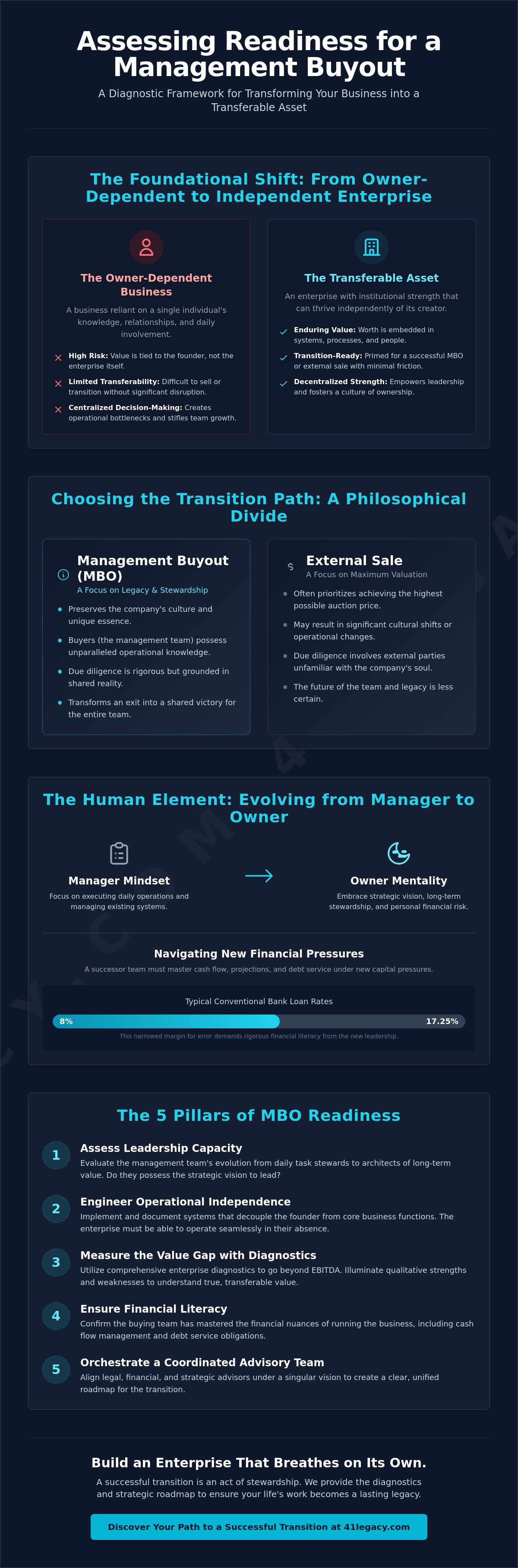
A Management buyout (MBO) represents the ultimate validation of an organization's structural integrity. It is not merely a change in equity; it's a transition of essence. True readiness exists at the rare intersection of management capacity and operational independence. It is the precise moment an enterprise ceases to be a reflection of its founder and begins to exist as a self-sustaining entity. For many, the business has been a lifelong masterpiece. Transforming that masterpiece into a transferable asset requires a shift in perspective, moving from the role of an owner-operator to that of a dedicated steward. Assessing company readiness for a management buyout demands an honest look at whether the foundation can support the weight of a new epoch. At 41 Legacy, we guide founders through this meticulous process, ensuring the business remains a living testament to their vision.
The Concept of the Transferable Asset
A business that relies on a single individual's magic is a lifestyle, not a legacy. A transferable asset possesses institutional memory that survives the departure of its creator. We utilize Enterprise Diagnostics to establish a baseline for this transition, looking far beyond the standard metrics of EBITDA. Assessing company readiness for a management buyout requires examining the qualitative factors of institutional strength. These include documented systems, decentralized decision-making, and the strategic capacity of a leadership team that has already begun to inhabit its future role. It's about ensuring the company's story continues with the same precision and excellence that defined its origin. Moving beyond simple profitability, we focus on the structural health that allows the entity to thrive without the founder's daily intervention.
MBO vs. External Sale: The Philosophical Divide
External sales often prioritize the highest auction price, sometimes at the expense of the company’s soul. In contrast, an internal transition focuses on preserving a legacy and maintaining the cultural fabric. Management teams are the most informed buyers in existence. They don't need a glossy brochure. They understand the granular technical excellence and the hidden risks within the operation because they've lived them. This transparency makes the due diligence process rigorous but grounded in reality. Choosing an internal path signals a commitment to long-term stability and the people who helped forge the enterprise. It transforms the exit into a shared victory, ensuring the impact of the business remains felt for generations. This path honors the history of the work while securing its future.
The Human Element: Gauging the Management Team's Strategic Capacity
The enterprise is a vessel, but the crew determines its ultimate destination. While the structural health of the asset is paramount, assessing company readiness for a management buyout involves a forensic evaluation of the human spirit. It is the transition from the "how" of daily operations to the "why" of long-term stewardship. Managers traditionally focus on the execution of existing patterns; owners must possess the vision to weave new ones. This shift requires a profound psychological evolution. The team must move beyond the safety of a paycheck and embrace the weight of personal financial risk. Without this "owner mentality," the most sophisticated transition plan remains a hollow exercise. True readiness is found when the successor team demonstrates a visceral commitment to the brand’s history and its future potential.
Financial literacy serves as the technical foundation for this evolution. It's not enough for a management group to understand a budget. They must master the nuances of cash flow velocity, projections, and the rigorous demands of debt service. In the current environment of June 2026, where conventional bank loan rates range from 8% to 17.25%, the margin for error has narrowed. A buying team must demonstrate they can maintain the company's essence while navigating these capital pressures. Identifying gaps in the collective skill set early allows for a more deliberate preparation phase, ensuring no detail of the legacy is left to chance.
Strategic Capacity Evaluation
Execution requires more than following a manual. It demands the ability to interpret market shifts and industry trends without the founder’s intuition as a safety net. We utilize a Strategic Capacity Evaluation to determine if the team can maintain the company’s trajectory independently. A unified vision among the buying group is essential. They must act as a single, cohesive entity, blending their individual strengths into a collective force capable of sustaining the enterprise’s unique market position.
The Leadership Transition Roadmap
A successful transfer is never an abrupt event but a choreographed sequence of authority hand-offs. The roadmap defines a clear timeline for delegating key decision-making powers, moving from mentorship to a formal governance structure. This process often includes creating a board-level oversight model to provide stability during the delicate early years of new ownership. Addressing potential conflicts of interest during negotiations is vital to preserve the trust that forms the backbone of the organization. This structured approach ensures the transition feels like a natural progression rather than a disruption of the company's soul.
Engineering Transferability: Reducing Owner Dependency
A business that relies on the singular brilliance of its founder is a masterpiece trapped within its frame. It cannot be moved, shared, or transitioned without risking total collapse. This phenomenon, often called the "Rainmaker Trap," occurs when the founder remains the primary driver of sales or the sole keeper of technical expertise. When assessing company readiness for a management buyout, one must determine if the enterprise possesses a life of its own or if it's merely a reflection of the owner's shadow. If the management team is to inherit the mantle of leadership, they must buy an asset that functions independently of the founder’s daily intuition. True stewardship involves the deliberate act of making oneself unnecessary. At 41 Legacy, we view this as a process of extraction, where the inner essence of the founder’s genius is distilled into repeatable, institutional systems.
We utilize a structured four-step process to achieve this level of independence. First, we document the implicit knowledge that governs the company's highest functions. Second, we delegate the execution of these tasks to the successor team. Third, we supervise the outcomes through rigorous metrics rather than direct intervention. Finally, we relinquish oversight entirely, allowing the business to breathe on its own. This technical precision ensures that the company's history is preserved while its future is secured.
The Role of SOPs in Value Growth
Standard Operating Procedures (SOPs) are the backbone of institutional memory. They transform individual talent into a collective capability. In an era where conventional bank loan rates for businesses can reach up to 17.25%, reducing the risk profile is essential for securing favorable financing. Documented processes provide lenders and management teams with the certainty that the enterprise will continue to perform post-transition. This "Transferability Engineering" directly influences the enterprise valuation. It moves the conversation beyond mere multiples of EBITDA and toward the inherent stability of the asset. A key part of this involves transitioning vital client and vendor relationships from the founder to the management group, ensuring the company's external bonds remain unbreakable.
Identifying and Mitigating Owner-Specific Risks
The "Founder Dependency Audit" is a forensic tool we use to identify hidden bottlenecks within the organization. It reveals where the owner’s involvement creates a ceiling for growth. Building strategic capacity within the middle management layer is the only way to break through this limit. The ultimate diagnostic is the "Vacation Test." If the business cannot grow and thrive while the owner is absent for an extended period, it's not yet ready for a transfer. Assessing company readiness for a management buyout requires the owner to step back so the team can step up. This creates a resilient structure that protects the legacy of the work and the people who perform it.
Enterprise Diagnostics: Measuring the Value Gap and Market Attractiveness
The bridge between a founder’s vision and a management team’s reality is built upon technical certainty. We define the "Value Gap" as the silent distance between the company’s current worth and the financial threshold required for the owner’s ultimate exit. Assessing company readiness for a management buyout requires a forensic examination of this space. It's not enough to hope the numbers align; one must verify the structural health of the asset through Enterprise Diagnostics. This process reveals how an objective outsider would view the entity, stripping away the emotional weight of ownership to expose the raw mechanics of the business. By utilizing Exit Readiness Assessments, we establish a clear baseline that informs every subsequent strategic decision. This technical clarity is the first step in assessing company readiness for a management buyout, providing the management team with a transparent view of the asset they will inherit.
The Financial Anatomy of an MBO
Normalizing earnings is a delicate art that requires adjusting financial statements to reflect the true performance of the business. This pro forma view is what lenders and management teams rely upon to determine debt capacity. With SBA 7(a) loan interest rates ranging from 9.75% to 13.25% in June 2026, the ability of the cash flow to service debt is a critical hurdle. We must balance the purchase price with the long-term health of the enterprise, ensuring the new owners aren't burdened by a structure that inhibits future growth. A successful buyout respects the history of the company’s profitability while securing its future liquidity.
Protecting Enterprise Value During Transition
True value is found in the resilience of the company’s revenue streams rather than just the volume of its sales. Identifying specific value drivers, such as high customer diversification or a high percentage of recurring revenue, allows the management team to prioritize what they must sustain post-closing. Diagnostics help us pinpoint these strengths before the transfer, creating a roadmap for value-growth initiatives that strengthen the company’s market attractiveness. This ensures the enterprise remains a vibrant, living entity that continues to thrive long after the founder has departed. You can begin this process today by securing an Enterprise Diagnostics evaluation to illuminate your path forward.
Orchestrating the Transition: The Role of the Advisory Quarterback
A management buyout is a complex composition that requires more than technical skill; it demands a unified direction. While attorneys focus on the structural integrity of the contract and CPAs analyze the tax implications of the transfer, the missing element is often a singular vision that binds these disciplines together. Assessing company readiness for a management buyout is only the prelude to the actual performance. Without a central "Quarterback" to coordinate the professional advisory team, the transition can descend into a series of disconnected transactions. We believe that true stewardship requires an elevated perspective that keeps the long-term health of the enterprise at the center of every conversation. This ensures the company’s essence remains intact while the ownership structure evolves.
Execution is where many transitions lose their momentum. Bridging the gap between a strategic plan and the daily reality of the business requires consistent, disciplined effort. Our Monthly Implementation Support provides the necessary friction against the gravitational pull of the status quo. It’s about more than just checking boxes; it’s about refining the organization until it functions as a truly transferable asset. By maintaining a steady and unhurried pace, we allow the management team to inhabit their new roles with confidence. This rhythmic approach to transition ensures that by the time the final documents are signed, the founder has already successfully extracted themselves from the core of the operation.
Coordinating the Professional Advisory Team
Professional silos are the greatest threat to a successful MBO. When tax planning, legal structure, and enterprise growth are not aligned, the result is often friction that devalues the asset. We act as the guardian of the owner’s legacy, ensuring that every advisor is moving toward the same "Exit Readiness" objective. This involves reducing the natural tension between the owner's personal financial goals and the strategic needs of the company. In the US, navigating the complexities of HSR rules or the specific burdens of new regulatory oversight requires a synchronized effort. We ensure that every decision serves the ultimate goal of preserving the enterprise's soul.
The Value Growth Roadmap
A legacy isn't built in a day. It requires a deliberate 12-to-36 month implementation plan that prepares the soil for the next generation of leadership. The Value Growth Roadmap serves as the definitive guide for this journey, establishing clear accountability structures for the management team. This period of preparation allows the successor group to prove their strategic capacity while the founder is still available to provide high-level guidance. The final step of this process is the establishment of an enterprise that thrives independently of any single individual. Assessing company readiness for a management buyout concludes when the business stands as a self-sustaining masterpiece, ready to endure for decades to come.
Securing the Future of Your Masterpiece
Your business is more than a series of ledger entries; it's a living narrative of dedication and technical excellence. Preparing for an internal transition requires a shift from active creator to silent guardian. By reducing owner dependency and cultivating strategic capacity within your team, you transform a founder-led enterprise into a timeless, transferable asset. This evolution ensures that the company's inner essence remains intact even as the hands at the helm change. It's the final act of stewardship for any founder who values heritage as much as performance.
The process of assessing company readiness for a management buyout is the ultimate diagnostic of your life's work. It reveals the structural health and institutional memory required for the organization to thrive in your absence. At 41 Legacy, our mission is to preserve the essence of your impact through a structured "Quarterback" advisory model. Led by a Certified Exit Planning Advisor (CEPA), we focus on long-term enterprise value growth to ensure your transition is as precise as the work that built the company. Secure your legacy with a comprehensive Exit Readiness Assessment from 41 Legacy.
The next epoch of your enterprise begins with a single, deliberate step toward strategic clarity. We're honored to help you navigate this transition with the reverence and precision your history deserves.
Frequently Asked Questions
What is the primary difference between a management buyout and an ESOP?
A management buyout involves a specific, hand-picked group of leaders acquiring equity to maintain the company's strategic direction. In contrast, an Employee Stock Ownership Plan (ESOP) is a broad-based retirement benefit where a trust holds shares for the benefit of the entire workforce. MBOs prioritize the strategic capacity of a select few to preserve the company's soul; while ESOPs focus on collective ownership and require significant regulatory oversight.
How do I determine if my management team can actually afford to buy the business?
Affordability is measured by the company’s ability to service debt through its own cash flow, rather than the personal savings of the management group. Most transitions utilize a combination of senior debt, seller notes, and a modest equity contribution from the team. With SBA cumulative loan limits increasing to $10 million starting July 4, 2026, many teams find the path to ownership more accessible through these structured financing options.
What is the 'Value Gap' and how does it affect my exit planning?
The Value Gap is the distance between the current enterprise value and the financial threshold you require to secure your personal legacy and lifestyle. If this gap is wide, it signals that the enterprise needs more time for value growth before the transfer can occur. Understanding this metric is essential for assessing company readiness for a management buyout because it dictates the necessary timeline for your implementation plan.
Can a management buyout succeed if I am still heavily involved in daily sales?
A transition is rarely successful if the founder remains the primary driver of revenue. This "Rainmaker Trap" creates a significant risk for the successor team and potential lenders because the business lacks independence. True transferability requires the owner to extract themselves from daily sales, ensuring the company’s essence and key relationships are institutionalized within the management group before the final hand-off occurs.
How long does the average management buyout transition take from assessment to close?
A thoughtful transition typically requires 12 to 36 months from the initial diagnostic to the final closing. This duration allows for the implementation of a Value Growth Roadmap and the deliberate reduction of owner dependency. Rushing this process risks the stability of the organization. A steady, unhurried pace ensures the management team is fully prepared to inhabit their new roles with confidence and precision.
What role does a Certified Exit Planning Advisor (CEPA) play in an MBO?
A Certified Exit Planning Advisor acts as the strategic architect of the entire transition process. They coordinate the professional advisory team, ensuring that legal, tax, and business growth strategies are aligned toward a singular goal. By serving as a "Quarterback," the CEPA protects the integrity of the legacy while utilizing diagnostics to maximize the long-term value of the transferable asset.
Should I tell my management team I am considering an MBO before I am ready?
Disclosure should only occur after you've conducted a formal evaluation of the enterprise’s structural health. Sharing your intentions too early can create uncertainty and distractions if the business isn't yet a viable candidate for transfer. Assessing company readiness for a management buyout privately allows you to build a solid foundation and a clear roadmap before inviting the team into the nuances of the transition.
What happens if the Enterprise Diagnostic shows the company isn't ready for a buyout?
If the diagnostic reveals a lack of readiness, it serves as a precise roadmap for future improvement rather than a terminal failure. It provides a forensic look at the structural changes needed to strengthen the asset’s value and independence. You then utilize Strategic Advisory and Monthly Implementation Support to address these gaps, ensuring the company eventually reaches the high standard required for a successful and lasting transition.

Article by
Mike Laskowski
Mike Laskowski is a Business Value Growth Strategist who helps business owners uncover the truths that drive their performance, risk, and readiness. Blending forensic interviewing from a 26‑year federal career with Strategic Capacity analysis and CEPA methodology, he works upstream to reduce owner dependency, increase transferability, and strengthen enterprise value. Mike guides founders through clarity, operational evolution, and transition readiness so their companies become transferable, owner‑independent assets that endure beyond the founder.
Disclaimer
This article is for educational and informational purposes only and does not provide legal, tax, investment, or business brokerage advice. 41 Legacy does not offer M&A brokerage services, legal document drafting, tax preparation, or investment advisory services. Business owners should consult licensed professionals in those disciplines before making decisions related to business transactions, legal matters, tax strategy, or financial planning. All examples are illustrative and may not apply to your specific situation.