
Architect's Guide to Business Exit Strategies
An architect doesn't design a monument to stand only as long as they are present to hold the doors open. Yet, many founders eventually realize their life's work functions more like a personal job than a lasting institution. You've likely felt the quiet weight of being the sole engine of your enterprise, fearing the structure might crumble the moment you step away. It's natural to feel uncertain about the true enterprise value or anxious about the complexity of a future transition. Mastering the different types of business exit strategies is the essential first step in evolving from owner-dependency toward true enterprise maturity.
We're here to provide the strategic clarity required to transform your firm into a resilient, transferable asset. This guide reveals the frameworks that ensure your legacy thrives long after your personal transition. We'll explore how Transferability Engineering and a Value Growth Roadmap prepare you for any path you choose. Whether you're considering an internal succession or a strategic acquisition, you'll gain a clear roadmap to becoming exit ready. By focusing on the inner essence of your business, you can secure the peace of mind that comes from building something that endures independently.
Key Takeaways
- Reframe the exit as a transition from founder-operator to legacy-steward, ensuring the business thrives as a transferable asset independent of your daily involvement.
- Evaluate the various types of business exit strategies to determine whether an internal succession or an external sale best preserves the intrinsic value of your life’s work.
- Use Enterprise Diagnostics to identify the Value Gap and quantify how owner dependency might be impacting your firm’s ultimate marketability.
- Institutionalize your processes through Transferability Engineering to transform a personal job into a resilient and attractive enterprise.
- Develop a structured Value Growth Roadmap that provides the strategic clarity necessary to move from uncertainty to a position of transition readiness.
The Philosophy of the Exit: Stewardship and the Transferable Asset
A true masterpiece is never finished; it is merely surrendered to the next generation of admirers. For the visionary founder, the eventual departure from their company shouldn't be viewed as a retreat or a final transaction. It is the ultimate act of stewardship. This evolution requires a shift from founder-operator to legacy-steward, where your primary objective becomes the preservation of the company’s inner essence. To achieve this, the enterprise must be forged into a transferable asset, a living entity capable of flourishing independently of its creator’s daily touch.
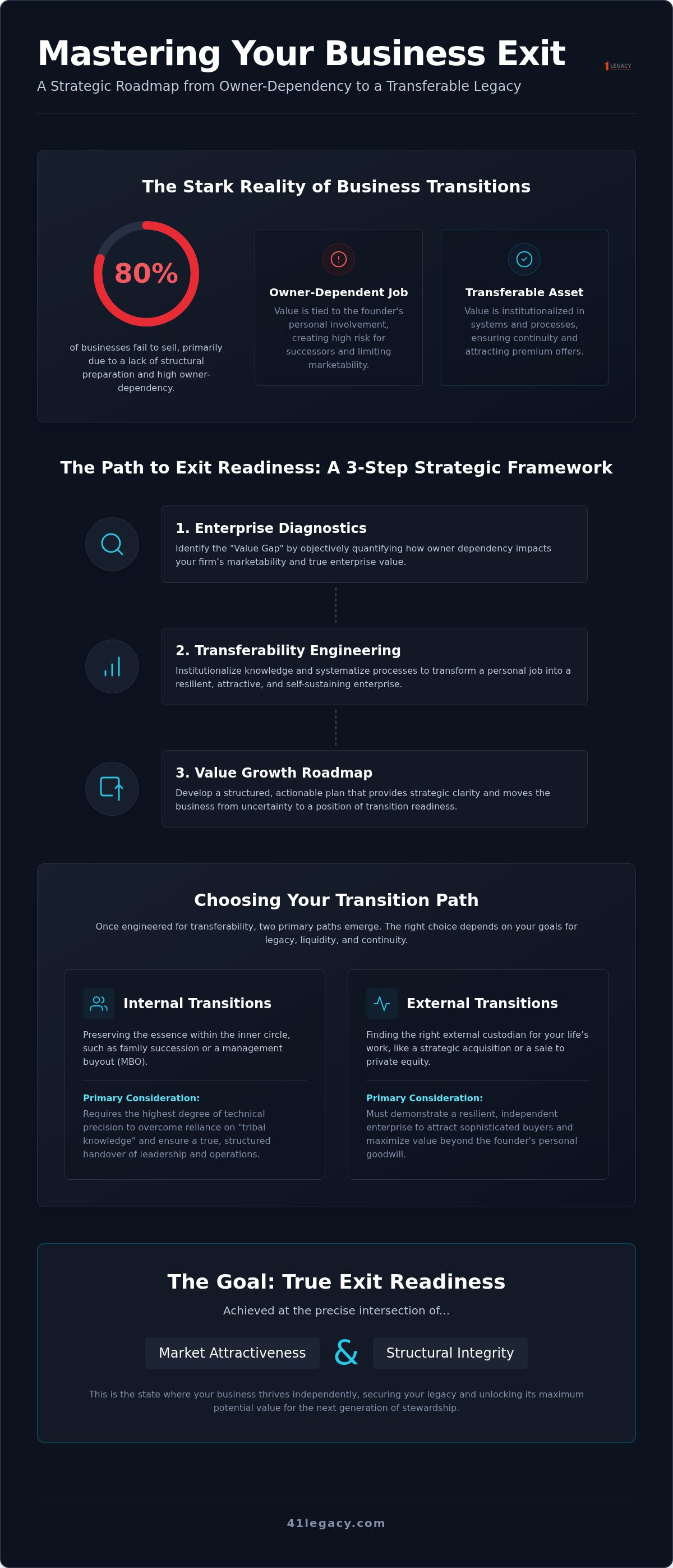
The reality of the market is often unforgiving to those who treat their exit as a reactive event. Industry data suggests that 80% of businesses fail to sell or transfer successfully. This staggering rate of failure isn't typically due to a lack of talent or revenue. Instead, it stems from a lack of structural preparation. True exit readiness is the precise intersection of market attractiveness and structural integrity. Without both, the work of a lifetime remains tethered to the individual, losing its luster the moment the founder steps away. Selecting the right path among the different types of business exit strategies requires a foundation of absolute clarity and tactical readiness.
The Master Craftsman’s Perspective
We believe your business is a masterpiece intended for a new gallery. You are currently the guardian of its story, but the most enduring legacies are those designed for continuity. Successful transitions don't happen by chance; they are the result of deliberate Transferability Engineering. The most sophisticated owners begin this process years in advance, treating the business as a separate organism that requires its own systems, culture, and leadership to breathe. By planning early, you ensure the essence of your work remains intact even as the hands on the wheel change.
Enterprise Value vs. Personal Income
It's easy to mistake a high-performing lifestyle business for a high-value enterprise. While a lifestyle business provides excellent personal income, it often suffers from extreme owner dependency. This dependency acts as a silent thief of company value, signaling to potential successors that the business cannot survive without the founder's specific genius. To build a legacy that commands respect, you must prioritize enterprise value over immediate draws. This involves a rigorous focus on How to Increase Enterprise Value by institutionalizing knowledge and diversifying strategic capacity. When the business can thrive without you, it finally becomes a prize worth holding. Navigating the various types of business exit strategies becomes a pursuit of excellence rather than a desperate search for an exit.
Internal Transitions: Preserving the Essence within the Inner Circle
Internal transitions represent a profound commitment to the continuity of a firm’s soul. When exploring the various types of business exit strategies, the choice to keep the legacy "in the house" or "in the family" often feels like the most reverent path. This route honors the history of the enterprise while providing a bridge to its future. However, this intimacy creates a unique structural challenge. Because the successor is already immersed in the existing culture, there is a dangerous tendency to rely on tribal knowledge rather than rigorous, documented systems. We believe that internal transitions actually require the highest degree of technical precision. Without The Blueprint for a Transferable Legacy, the business remains tethered to the founder’s intuition, making a true handoff impossible.
Financial reality also plays a central role in these transitions. The owner’s need for liquidity must be balanced against the successor's financial capacity. This requires a sophisticated approach to deal structuring that ensures the health of the enterprise remains the priority. By focusing on Transferability Engineering, we help owners prepare their inner circle for the weight of stewardship, ensuring the transition is a seamless evolution rather than a disruptive event.
Family Succession
The transition from the first generation (G1) to the second (G2) is a delicate dance between heritage and performance. It isn't enough to share a lineage; the successor must possess the technical skill and strategic vision to sustain the masterpiece. We utilize a formal Strategic Capacity Evaluation to ensure that the next generation is prepared to act as the new guardians of the company’s essence. This objective assessment removes emotional bias, allowing for a transition based on merit and readiness rather than just tradition. Ensuring the business survives this shift is the ultimate test of an owner's foresight.
Management and Employee Buyouts (MBOs)
Rewarding the lieutenants who helped build your fortress is a noble way to conclude your tenure. In an MBO, the transition is often structured using seller notes or outside financing, which requires a deep understanding of the firm's cash flow. A critical risk here is the "Rainmaker Trap." If the management team cannot generate new revenue without your personal involvement, the buyout remains fragile. We work with owners to dismantle this dependency, ensuring the team can lead the business into its next chapter with confidence. Understanding how these types of business exit strategies function allows you to reward loyalty without compromising the firm’s stability.
Employee Stock Ownership Plans (ESOPs)
For firms seeking broad-based ownership, the ESOP serves as a powerful vehicle for cultural preservation and tax efficiency. Turning employees into owners transforms the very fabric of the organization, aligning every hand toward the same standard of excellence. As of 2026, there are approximately 6,609 ESOPs in the U.S., covering 15.1 million participants. These plans are complex and require a sophisticated advisory team to execute correctly. As your "quarterback," we coordinate the technical details to ensure the ESOP aligns with your long-term vision. Before committing to this path, an Enterprise Diagnostic can help determine if your culture is prepared for the shift to employee ownership.
External Transitions: Finding the Right Custodian for Your Life’s Work
The open market is a gallery of discerning collectors. For the founder who has spent decades refining their craft, an external sale represents the opportunity to find a custodian who truly recognizes the enterprise’s intrinsic value. While internal transitions focus on the inner circle, external types of business exit strategies seek a partner capable of taking the masterpiece to a global stage. However, market attractiveness is only half the battle. A buyer might be drawn to your industry's growth, but they'll only commit if they see structural integrity. Before engaging the market, a firm must undergo rigorous Transferability Engineering to ensure it can function without the founder’s daily presence. Understanding the nuances of Determining Enterprise Value is the first step in speaking the language of these sophisticated outsiders.
Strategic vs. Financial Buyers
External buyers generally fall into two categories, each viewing your business through a different lens. Strategic buyers are often competitors or companies in adjacent industries. They look for synergy, believing that your firm’s essence added to theirs will create a "1+1=3" effect. Financial buyers, such as private equity firms, view your company as a platform for scale. They're interested in the mechanical excellence of your operations and the reliability of your cash flow. The choice between them dictates your role after the transition and the ultimate legacy of the brand.
| Buyer Type | Primary Motivation | Operational Control | Post-Exit Role |
|---|---|---|---|
| Strategic | Synergy and Market Share | High Integration | Minimal / Short Transition |
| Financial | ROI and Scalability | Operational Autonomy | Often 1-3 Year Retainment |
The Third-Party Sale
Navigating a third-party sale requires a level of preparation that goes far beyond traditional bookkeeping. You aren't just selling a list of assets; you're transferring a living system. This is where the role of the "Quarterback" becomes indispensable. We coordinate with your CPAs and attorneys to prepare the data room, ensuring every document reflects the meticulous nature of your work. Clean, pro forma financials are more than just numbers. They are the language of external trust. When your financials are polished to a high sheen, you signal to the market that the enterprise is a professionalized asset ready for its next chapter. By focusing on these structural details, you move from being a seller to being a steward of a highly coveted prize.
The Diagnostic Framework: Assessing Your Strategy’s Viability
Strategic clarity isn't found in a brochure; it's forged through data. While understanding the various types of business exit strategies is essential, choosing the right path requires a cold, objective assessment of your firm’s current state. Many founders operate under a veil of optimism regarding their company’s worth, only to discover a "Value Gap" during the transition process. This gap represents the distance between your current enterprise value and the liquidity required to fund your next chapter. Identifying this delta early is the only way to ensure your life’s work provides the freedom you’ve earned.
We believe that viability is a technical measurement, not a feeling. This measurement begins with Owner Dependency Diagnostics, which quantify exactly how much the business relies on your personal involvement to generate revenue and maintain operations. If the essence of the firm is tied exclusively to your presence, your options for transition are severely limited. We also conduct a Strategic Capacity Evaluation to determine if your existing leadership team possesses the skill and temperament to execute a handoff. To ensure these elements align, we act as the "quarterback" for your advisory team, coordinating with your CPA, attorney, and wealth manager to maintain a unified vision for the enterprise.
Enterprise Diagnostics
We take a surgical look at the eight drivers of company value to establish a baseline of structural health. This process identifies the "red flags" that devalue a business in the eyes of a sophisticated buyer or successor, such as customer concentration or a lack of institutionalized knowledge. By addressing these flaws through Transferability Engineering, we move the business from a personal job to a professionalized asset. To understand how this specialized oversight protects your interests, explore the role of The CEPA: Architect of Your Business Legacy.
The Value Growth Roadmap
A diagnostic only holds value if it leads to action. Our Value Growth Roadmap transitions you from assessment to implementation through a structured monthly advisory rhythm. This process focuses on building a transferable asset that remains "ready for exit" at any time, regardless of when you choose to step away. By prioritizing meticulous documentation and process refinement, we reduce the inherent risks of transition and increase the multiples of your enterprise value. To begin your own transition journey, we recommend a formal Exit Readiness Assessment to establish your baseline and determine which types of business exit strategies are truly viable for your firm.
Engineering Your Legacy: The Path to Exit Readiness
Transitioning from a masterpiece you've spent years refining requires a discipline that matches your creative drive. Readiness isn't an event; it's a state of structural excellence. Regardless of which types of business exit strategies you find most compelling, the journey toward a successful transition follows a rigorous, five-step progression designed to protect the firm's essence while maximizing its value.
- Step 1: Conduct a formal Enterprise Diagnostic. This establishes a baseline of your firm's current health, identifying exactly where value is being preserved or leaked.
- Step 2: Identify and mitigate Founder Dependency risks. We systematically transfer your unique genius into documented processes, ensuring the business can breathe without your constant presence.
- Step 3: Draft a Value Growth Roadmap. This document outlines clear, actionable milestones that bridge the gap between your current worth and your ultimate liquidity needs.
- Step 4: Coordinate your professional advisory team. We act as the central "Quarterback," aligning your CPAs, attorneys, and wealth managers toward a singular strategic vision.
- Step 5: Execute with monthly implementation support. True transformation occurs in the rhythm of accountability, ensuring every refinement is polished to a high sheen.
The Role of the Strategic Advisor
A successful transition requires an advocate who's deeply invested in the health of the enterprise rather than the speed of a transaction fee. We position ourselves as the Guardian of the Legacy throughout the growth phase. Our focus remains on Transferability Engineering, ensuring that when you do choose to step away, you're handing over a prize, not a burden. This level of oversight provides the strategic depth needed to navigate the complexities of Exit Planning for Business Owners with absolute confidence.
Your Next Chapter
The transition is not just a financial milestone; it's the beginning of your Third Act. Preparing for life after business requires as much intention as building the company itself. We help you ensure that your personal fulfillment and financial security are harmonized, allowing you to walk away with the peace of mind that your life's work will endure. Your legacy is a living history, and its next chapter depends on the precision of your current preparation. We invite you to Discover your current Exit Readiness with 41 Legacy and begin the process of securing your firm's future.
Securing the Future of Your Masterpiece
The journey from founder to steward requires more than a simple desire to step away; it demands the technical precision of Transferability Engineering. By evaluating the various types of business exit strategies, you've taken the first step toward transforming your life's work into a resilient, transferable asset. You now understand that true enterprise value isn't found in your daily presence, but in the systems and culture that thrive in your absence. This structural integrity is the only way to ensure your masterpiece endures long after your transition.
At 41 Legacy, we provide the CEPA-led strategic advisory necessary to bridge the gap between your current worth and your ultimate liquidity needs. We act as the quarterback for your existing advisors, coordinating every detail to ensure your transition is a seamless evolution. It's time to move from uncertainty to a position of absolute strategic clarity. Begin Your Enterprise Diagnostic with 41 Legacy today. Your dedication to excellence deserves a legacy that reflects the same uncompromising standard you've maintained since the beginning.
Frequently Asked Questions
What is the most common business exit strategy for small to mid-sized firms?
Third-party sales to strategic or financial buyers remain the most frequent route for small to mid-sized firms. In the first quarter of 2026, M&A transactions accounted for 68.4% of startup exits, reflecting a stabilized market. However, internal transitions like management buyouts are also prevalent. Regardless of the path, understanding the different types of business exit strategies allows you to choose the one that best preserves your firm's intrinsic essence and historical impact.
How early should I begin planning for my business exit?
You should ideally begin the formal planning process three to five years before your intended transition. This window is necessary to conduct thorough Enterprise Diagnostics and implement a Value Growth Roadmap. Building recurring revenue and reducing owner dependency are time-intensive mechanical processes. Early preparation ensures that when the time arrives, the business is a polished, transferable asset rather than a project requiring immediate repair or deep structural intervention.
What is the difference between an exit plan and a succession plan?
An exit plan focuses on the owner's financial goals and personal transition, while a succession plan addresses the leadership and operational continuity of the firm. While they're distinct, they must be harmonized to ensure the enterprise survives the change in stewardship. We act as the quarterback to ensure your exit strategy aligns with the development of the next generation of leadership, protecting the company's inner essence throughout the handoff process.
How does owner dependency affect the types of exit strategies available to me?
High owner dependency significantly restricts your options and often devalues the enterprise in the eyes of sophisticated buyers. If the firm's success is tethered to your personal genius, external types of business exit strategies become difficult to execute. Reducing this dependency is a core pillar of Transferability Engineering. When the business can thrive without your daily touch, it opens the door to premium valuations from strategic buyers or stable management buyouts.
Can I change my exit strategy once I have started the process?
You can certainly pivot your strategy if you've built the business as a transferable asset. A common goal of our advisory support is to make the business "exit ready" at any time, providing you with maximum flexibility. If a strategic buyer offers a compelling multiple, you can pivot from an internal succession to an external sale. This strategic agility is only possible when your structural integrity is high and your financials are professionalized.
What role does a Certified Exit Planning Advisor (CEPA) play in choosing a strategy?
A Certified Exit Planning Advisor (CEPA) serves as the strategic architect and quarterback for your entire advisory team. We coordinate with your CPA, attorney, and wealth manager to ensure every decision moves the needle on enterprise value. By utilizing structured Enterprise Diagnostics, a CEPA helps you identify the Value Gap and select the most appropriate strategy based on data rather than intuition, ensuring a professionalized transition process that protects your life's work.
Is liquidation considered a viable exit strategy for a healthy business?
Liquidation is rarely a viable choice for a healthy enterprise because it often recovers only the value of the tangible assets. This process ignores the "goodwill" and the living systems you've spent years engineering. For a masterpiece business, liquidation represents a failure of stewardship. Instead, we focus on Value Growth Roadmaps that transform the company into a prize that a successor or buyer would be honored to curate for the long term.
How do I know if my business is ready for a management buyout (MBO)?
A business is ready for an MBO when the management team demonstrates the strategic capacity to lead without the founder's intervention. This readiness is quantified through Owner Dependency Reduction and a formal Strategic Capacity Evaluation. If your lieutenants can maintain the company's essence and drive revenue independently, the firm has the structural integrity required for a buyout. Without documented SOPs and institutionalized knowledge, an MBO remains a high-risk endeavor for all parties.

Article by
Mike Laskowski
Mike Laskowski is a Business Value Growth Strategist who helps business owners uncover the truths that drive their performance, risk, and readiness. Blending forensic interviewing from a 26‑year federal career with Strategic Capacity analysis and CEPA methodology, he works upstream to reduce owner dependency, increase transferability, and strengthen enterprise value. Mike guides founders through clarity, operational evolution, and transition readiness so their companies become transferable, owner‑independent assets that endure beyond the founder.
Disclaimer
This article is for educational and informational purposes only and does not provide legal, tax, investment, or business brokerage advice. 41 Legacy does not offer M&A brokerage services, legal document drafting, tax preparation, or investment advisory services. Business owners should consult licensed professionals in those disciplines before making decisions related to business transactions, legal matters, tax strategy, or financial planning. All examples are illustrative and may not apply to your specific situation.

