
Aligning Business Value with Personal Financial Goals: The Path to Strategic Freedom
If you were to step away from your enterprise today, would the legacy you've meticulously crafted continue to flourish, or would its heartbeat falter without your constant presence? This question haunts many founders who find themselves caught in the Rainmaker Trap, where the business's vitality is tethered solely to their individual efforts. You've likely spent years pouring your essence into the organization, yet you may still feel a profound uncertainty regarding its true market worth. True stewardship requires aligning business value with personal financial goals to ensure your life's work translates into lasting security.
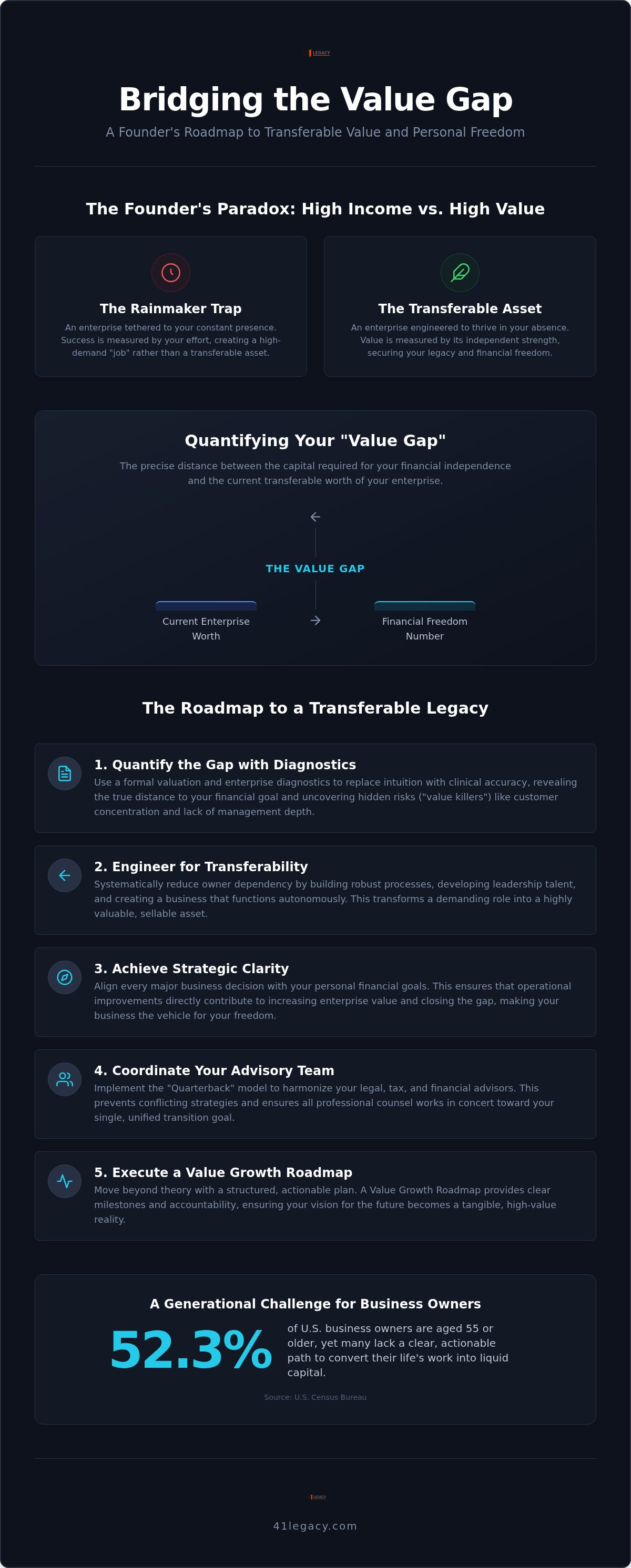
We understand the weight of this responsibility. In this article, you'll discover how to identify and bridge the Value Gap between your current enterprise worth and the capital required for your ultimate freedom. We'll examine the architecture of a transferable asset and provide a roadmap for reducing owner dependency. By the end, you'll have the strategic clarity needed to harmonize your professional achievements with your personal aspirations, ensuring your business remains a vibrant, independent entity that thrives for generations to come.
Key Takeaways
- Quantify the "Value Gap" through Enterprise Diagnostics. This foundational step reveals the exact distance between your current enterprise worth and your ultimate financial requirements.
- Master the discipline of transferability engineering. By building a business that functions without you, you transform a demanding role into a valuable, transferable asset.
- Achieve profound strategic clarity by aligning business value with personal financial goals. This ensures every operational decision strengthens your legacy and secures your future.
- Discover the "Quarterback" model of advisory coordination. This approach harmonizes your legal, tax, and financial advisors to prevent conflicting strategies during your transition.
- Utilize a Value Growth Roadmap to move beyond theory. Structured implementation support ensures your vision for the future becomes a tangible, high-value reality.
The Conflict Between Enterprise Success and Personal Freedom
Many founders mistake a high-performing income stream for a high-value asset. It's a common paradox. You've built a company that generates impressive revenue, yet it remains an untransferable "job" because it cannot function without your daily presence. True success isn't measured by the intensity of your involvement. It's measured by the business's ability to thrive in your absence. This realization is the first step toward aligning business value with personal financial goals, ensuring your life's work serves your future rather than consuming it.
You aren't merely a manager of operations. You're a steward of a legacy. This perspective requires that personal aspirations dictate the strategic direction of the enterprise, not the other way around. When the business consumes the owner's time without building transferable worth, the architectural integrity of the mission is compromised. We believe the enterprise should be a vehicle for your ultimate freedom, not a cage that limits it.
The Essence of Strategic Alignment
Moving from survival mode to legacy mode requires a fundamental shift in vision. We view the business as a masterpiece of engineering. Like a fine timepiece, every gear must be designed to turn without the constant hand of its creator. There's a significant emotional weight to this process. It involves letting go of the identity of the "Rainmaker" to embrace the role of the visionary architect. This transition ensures that the essence of what you've built survives your eventual departure, preserving the provenance of your work for the next generation of leadership.
Why Traditional Wealth Planning Often Fails Owners
Standard wealth planning often overlooks the most significant portion of an owner's net worth. Many advisors focus exclusively on the 20% of assets held in public markets, largely ignoring the illiquid nature of the business itself. This creates a dangerous imbalance. According to the U.S. Census Bureau, 52.3% of business owners are aged 55 or older, yet many lack a clear path to liquidity. Strategic Clarity is the deliberate alignment of enterprise value with personal requirements, serving as the antidote to reactive, short-term decision-making. Without this alignment, an owner remains "asset rich but cash poor," unable to extract the value they've spent decades creating. You can begin exploring this alignment at 41 Legacy, where we focus on bridging this critical gap.
Quantifying the Value Gap: The Diagnostic Foundation
Precision is the hallmark of the master artisan. In the pursuit of aligning business value with personal financial goals, one cannot rely on the shifting sands of intuition or optimistic projections. A formal valuation is the only way to replace "gut feeling" with clinical accuracy. Most owners possess a deep, emotional understanding of their work, yet they often lack a forensic view of what a third party would actually pay for it. Without this foundation, you risk building a future on a deficit you didn't know existed.
We define the "Value Gap" as the critical distance between your current enterprise worth and the liquid capital required to secure your lasting independence. This isn't a static number. It's influenced by market attractiveness and internal readiness. A business that's highly profitable but entirely dependent on the founder may fetch a much lower multiple than a leaner, autonomous operation. Understanding this gap is the first step toward reclaiming your time and securing your legacy.
Enterprise Diagnostics: Measuring What Matters
True value often lies beneath the surface of the balance sheet. Through a process of Enterprise Diagnostics, we identify the hidden risks that erode enterprise worth in the eyes of a potential successor. These "value killers" frequently include customer concentration, weak management depth, or a lack of documented processes. Financial transparency is equally vital. Clean, auditable records act as a seal of quality, ensuring that your company's history is presented with the clarity it deserves. You can begin this discovery process with an Exit Readiness Assessment to reveal exactly where your asset stands today.
Calculating Your Financial Independence Number
Your "walk-away" number must be calculated with surgical precision. It's the post-tax liquidity needed to sustain your lifestyle, account for inflation, and fund your philanthropic legacy. With the federal estate and gift tax exemption reaching $15 million per person in 2026, the stakes for proper alignment are immense. A Chase Survey from May 2026 revealed that 70% of small business owners are in the early stages of planning or have no formal plan at all. A Value Growth Roadmap serves as the bridge across this gap. It transforms strategic vision into a sequence of measurable improvements, ensuring that when the time comes to transition, the harvest matches the decades of labor you've invested.
Engineering Transferability to Fund Your Personal Legacy
Value is frequently misidentified as mere profitability. While a robust income statement is a necessary component, it is insufficient to support a lasting legacy. True enterprise worth resides in the organization's capacity to function as a self-sustaining entity, entirely independent of its creator's daily input. By aligning business value with personal financial goals, you move beyond the limitations of active management into the realm of strategic stewardship. This deliberate evolution ensures the business becomes a transferable asset, capable of funding your future without requiring your presence.
Standard Operating Procedures (SOPs) serve as the meticulous blueprints for this transformation. They are not simply administrative checklists; they represent the encoded DNA of your vision. We recommend exploring what is an SOP in business to understand how these documents act as the bridge between personal effort and institutional excellence. Reducing owner dependency is the single most effective way to enhance market attractiveness and ensure a smooth transition of leadership.
The Architecture of a Transferable Asset
Consistency is the guardian of reputation. Documenting processes ensures that every execution mirrors the precision of the founder's original intent, even when the founder isn't in the room. Beyond documentation, you must cultivate a leadership tier that understands and protects the inner essence of the brand. These specialists must be empowered to make decisions that reflect your standards without needing your direct approval. Transferability Engineering is a meticulous craft that converts a personal vocation into a durable, institutional masterpiece.
Protecting Value Through Strategic Capacity
Buyers evaluate a business based on its future resilience. Strategic Capacity is the measure of whether your infrastructure can handle significant growth without compromising quality or operational integrity. If the business is already operating at its limit, a buyer sees risk rather than opportunity. However, when systems are engineered for scalability, the multiple applied to your earnings increases accordingly. You can discover additional methods on how to increase enterprise value by focusing on these structural foundations. This alignment ensures that the asset you've spent a lifetime building is finally ready to stand alone, providing the financial freedom you've earned.
The Quarterback Strategy: Coordinating the Professional Advisory Team
Precision requires orchestration. High-stakes transitions demand a level of harmony that siloed advice simply cannot provide. Most business owners surround themselves with talented specialists, yet these experts often operate in isolation, focused on their specific disciplines rather than the collective mission. This lack of coordination is a significant risk to aligning business value with personal financial goals. Without a unified front, the architectural integrity of your legacy is left to chance.
Conflicts between professional domains are common. A CPA may focus on aggressive tax mitigation strategies that inadvertently reduce reported EBITDA, which is the very metric a buyer uses to determine enterprise worth. Simultaneously, an attorney might draft estate documents that don't reflect the current operational reality of the business. These contradictions create friction that can erode millions in value. The "Quarterback" strategy ensures that every specialist serves your "North Star" with surgical precision, preventing costly misalignments before they occur.
Aligning Tax, Legal, and Strategic Interests
Every legal document and tax election must reflect the reality of your Value Growth Roadmap. It's insufficient for a CPA to see your financials only during tax season. They need to understand the long-term trajectory of the enterprise to ensure their advice supports future liquidity rather than just immediate savings. Maintaining a "professional-room altitude" means ensuring your advisors speak the same language. When legal structures, tax planning, and strategic growth are synchronized, the business becomes a more resilient, transferable asset. This level of coordination is rare, yet it's essential for those who refuse to settle for anything less than perfection.
The Role of 41 Legacy as Strategic Advisor
We serve as the guardian of the owner's vision across all professional disciplines. By acting as the strategic lead, we provide the structured process that keeps the entire advisory team accountable to your ultimate objectives. This reduces the exhausting burden on the owner to act as a translator between different experts. We don't replace your trusted CPAs or attorneys; we empower them to work more effectively by providing a clear, unified direction. You can begin building this coordinated front by engaging with our Strategic Advisory services, ensuring your professional team is as dedicated to your legacy as you are.
Executing the Roadmap: From Vision to Exit Readiness
Vision without execution is a hollow pursuit. For the business owner, the transition from theoretical planning to tangible results is where true stewardship is tested. The discipline of aligning business value with personal financial goals requires a sustained commitment to implementation. It's not enough to identify the Value Gap; you must actively close it through deliberate, measured action. Strategic Clarity serves as the guiding principle for every daily operational decision, ensuring that the enterprise moves closer to its ultimate purpose with every passing month.
Monitoring this progress is essential. We utilize recurring diagnostics to track the closure of the Value Gap, providing a forensic view of how specific improvements impact enterprise worth. Whether you eventually pursue an internal transition to family or employees, or an external transition to a strategic successor, the goal remains the same. You're building a finished asset that reflects the excellence of your career. This is the culmination of your journey as a founder, where the business finally achieves the independence required to sustain your legacy.
Maintaining Momentum Through Accountability
The gravity of daily operations often pulls owners away from strategic work. To counteract this, we provide Monthly Implementation Support to ensure the roadmap remains the priority. Recurring advisory retainers provide the necessary structure to overcome "Day-to-Day" distractions that often stall progress. We focus on celebrating the milestones of owner-dependency reduction, such as the successful delegation of a critical process or the maturation of a leadership tier. These small victories are the indicators of a healthy, transferable asset that is growing in market attractiveness.
The Finished Asset: A Legacy Secured
Success is defined by the creation of a business that can thrive for generations without your intervention. When the architecture of the enterprise is sound, it commands a premium in the market and provides the peace of mind that comes from knowing your personal goals are fully funded. This is the ultimate expression of your craft. You've transformed a personal vocation into a durable institution. To begin this journey and ensure your life's work is protected, you can secure your legacy with an Exit Readiness Assessment today.
Securing the Future of Your Masterpiece
Your business is a testament to your dedication, yet its ultimate value is realized only when it can stand independently. By quantifying the Value Gap and engineering transferability, you transform a life of labor into a lasting, transferable asset. The process of aligning business value with personal financial goals ensures that your professional achievements directly fund your personal freedom. This requires a coordinated effort where every advisor operates in harmony toward your singular vision.
We invite you to move beyond the day-to-day and embrace the role of the visionary architect. With our Certified Exit Planning Advisor (CEPA) leadership and structured Value Growth Roadmap, we provide the precision and monthly implementation support needed to secure your future. Begin your journey toward strategic clarity with 41 Legacy. You've spent years building your legacy; it's time to ensure it thrives far beyond your tenure.
Frequently Asked Questions
What is the difference between business value and enterprise value?
Enterprise value is a technical calculation representing the total worth of the business, accounting for equity, debt, and cash reserves. Business value often refers to the broader worth of the entity to its current owner. We focus on transferable value, which is the price a successor pays for the company's future cash flows. This distinction is vital for understanding what capital will actually be available to you after a transition.
How do I know if my business is ready for an exit readiness assessment?
You are ready for an assessment the moment you realize the business cannot flourish without your daily intervention. This diagnostic isn't reserved for those planning an immediate departure. Instead, it serves as a forensic evaluation of the company's structural health. If you feel a disconnect between your professional success and your personal freedom, an assessment provides the clinical data needed to begin the refinement process.
Can I align my business value with personal goals if I don't plan to sell soon?
Strategic alignment is most effective when initiated years before a transition. By aligning business value with personal financial goals early, you create a more resilient and profitable organization today. This proactive approach allows you to build a "Value Growth Roadmap" that enhances current distributions while simultaneously engineering a masterpiece that will eventually stand alone. It's about stewardship, not just a transaction.
What is a 'Value Gap' and why does it matter for my retirement?
The Value Gap is the difference between your current net proceeds from a transition and the capital required to fund your legacy and lifestyle. If this gap remains unaddressed, your retirement goals may be compromised. Identifying this deficit allows us to prioritize the specific operational improvements that will bridge the distance. It's the primary metric we use to ensure your life's work fully supports your future independence.
How does reducing owner dependency actually increase my company's worth?
Reducing owner dependency lowers the perceived risk for any potential successor. When a business is tethered to a founder's individual effort, it's a fragile asset. By engineering autonomous systems and a robust leadership tier, you transform the enterprise into a durable institution. Buyers pay a premium for predictability and repeatability. A company that functions without its creator is inherently more valuable and commands a higher multiple in the market.
Why do I need a strategic advisor if I already have a CPA and an attorney?
A strategic advisor acts as the "Quarterback" who harmonizes the efforts of your entire professional team. While CPAs and attorneys are masters of their specific niches, they often operate in silos. Without a central lead to coordinate their efforts, you risk receiving conflicting advice that could erode enterprise worth. We ensure every legal and tax decision is perfectly synchronized with your long-term vision for growth and transferability.
What are the first steps to creating a Value Growth Roadmap?
The journey begins with Enterprise Diagnostics to uncover the specific drivers and detractors of your company's worth. We forensicly analyze your operations to identify where value is being lost. Once we quantify your Value Gap, we design a structured plan to enhance transferability and reduce risk. This roadmap serves as the definitive blueprint for your transition from an active manager to a strategic steward of a high-value asset.
How long does it typically take to bridge a significant Value Gap?
Meaningful value growth is a thoughtful process of craftsmanship that generally requires 12 to 36 months of dedicated effort. This timeline allows for the meticulous engineering of Standard Operating Procedures and the development of a capable leadership team. It's a steady, unhurried progression that ensures every structural improvement is polished to a high sheen. This commitment ensures the final asset is ready to thrive long after your departure.

Article by
Mike Laskowski
Mike Laskowski is a Business Value Growth Strategist who helps business owners uncover the truths that drive their performance, risk, and readiness. Blending forensic interviewing from a 26‑year federal career with Strategic Capacity analysis and CEPA methodology, he works upstream to reduce owner dependency, increase transferability, and strengthen enterprise value. Mike guides founders through clarity, operational evolution, and transition readiness so their companies become transferable, owner‑independent assets that endure beyond the founder.
Disclaimer
This article is for educational and informational purposes only and does not provide legal, tax, investment, or business brokerage advice. 41 Legacy does not offer M&A brokerage services, legal document drafting, tax preparation, or investment advisory services. Business owners should consult licensed professionals in those disciplines before making decisions related to business transactions, legal matters, tax strategy, or financial planning. All examples are illustrative and may not apply to your specific situation.